Circular and Fair ICT (CFIT) Pact in Ljubljana: Rethinking Sustainable IT Procurement
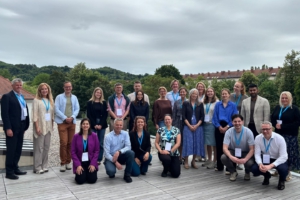
How can IT procurement become more circular, transparent and future-ready? At the CFIT meeting in Ljubljana, international experts explored practical approaches to sustainable hardware, cloud services, AI and contract management. From 2 to 4 June 2026, representatives of the Circular and Fair ICT Pact (CFIT) met in Ljubljana to discuss current challenges and new approaches to more sustainable IT procurement. The discussions focused on the circular economy, the reuse of IT hardware and contract management, environmental labels, and the sustainable procurement of data centers, cloud services, software and artificial intelligence applications.
The meeting once again demonstrated that sustainable IT procurement goes far beyond selecting individual products. Increasing attention is also being paid to implementing sustainability requirements throughout the contract term, data transparency, and the environmental impacts of digital infrastructure and services.
Sustainability does not end with contract award
A key topic was how sustainability requirements can be ensured throughout the entire contract term. The experience of many organizations shows that, although requirements are often embedded in tenders, their implementation is only monitored to a limited extent afterwards.
The participants therefore discussed approaches to systematically documenting and tracking sustainability requirements, evidence and responsibilities throughout the contract term. The aim is to create transparency and enable continuous improvement during the life of the contract.
Digital infrastructure and services are receiving greater attention
While sustainable procurement in the IT sector has so far often focused on hardware, the perspective is increasingly broadening to include other areas.
The following topics were discussed in particular:
- Data centers and data storage, cloud services, software, and artificial intelligence applications
This development reflects the increasing digitalization of public and private organizations. It is therefore becoming increasingly important to consider how sustainability requirements can also be effectively incorporated into the procurement of digital infrastructure and services.
Guidance through evidence
Evidence of environmental performance was also discussed. It continues to be regarded as an important tool for integrating sustainability requirements into procurement processes in a transparent and verifiable manner.
Representatives of EPEAT and TCO Certified presented recent developments in their respective systems. It became clear that environmental labels not only help verify specific sustainability requirements but can also guide procurement bodies in formulating appropriate requirements.
Extending service life and reuse as key levers
Another focus was on how to extend the useful life of IT hardware and promote the reuse of devices. Possible models for taking back, refurbishing and remarketing used equipment were discussed. It became clear that the circular economy is not solely a technical issue. Transparent processes, traceable quality standards, data security and ease of use are equally important.
Carbon data is becoming increasingly strategically relevant
Carbon data is becoming increasingly important for many organizations. Carbon and other environmental data can help procurement bodies better understand the climate impacts of products and services and make strategic decisions. At the same time, it became clear that comparability, data quality and transparent assessment methods are essential prerequisites for using such data in procurement.
Cloud services and AI as new sustainability topics
Beyond IT hardware itself, the impacts of cloud services and artificial intelligence were also addressed. In the area of cloud services, the discussion focused in particular on resource use, transparency regarding energy consumption and environmental impacts, and the underlying data center services.
With regard to artificial intelligence applications, the discussion focused especially on how energy and resource consumption, as well as the associated environmental impacts, can be made more transparent and taken into account in procurement decisions. At the same time, there is a growing need for methods and indicators that enable these impacts to be assessed transparently.
Guidance and support through CFIT recommendations
The recommendations developed within the framework of CFIT provide public procurement organizations with valuable guidance on implementing circular economy principles and sustainability in the IT sector. More information is available here: CFIT Publications | Circularandfairictpact They bring together experience from different countries and organizations and present practical approaches. They also provide support in addressing challenges associated with applying sustainable procurement criteria and promote knowledgesharing within the community. At present, they can serve in particular as guidance for the further development of organizations’ own procurement practices.
Exchange as an important success factor
Alongside the technical content, the meeting above all highlighted the value of international cooperation. Many issues – from the circular economy and supply chains to cloud services and AI – affect numerous organizations in similar ways. The exchange also encouraged participants to engage with new and still relatively unestablished areas.
Networks such as CFIT provide opportunities to exchange experiences, learn from one another and identify new developments at an early stage. This enables existing approaches to be further developed more quickly and successful solutions to be shared across national borders.
For organizations seeking to advance sustainable IT procurement, the value of participating therefore lies not only in access to specialist knowledge but also in direct exchange with experts from administration, procurement and the market.
Sustainable procurement cannot be achieved through individual criteria or certifications alone. Cooperation, knowledge transfer and the exchange of experience between organizations are equally important. Future challenges can be addressed more effectively by sharing experience and knowledge. CFIT supports this exchange and contributes to the development of common solutions.
Further information about CFIT and opportunities to get involved can be found here: Home | Circularandfairictpact
Weiterführende Links:
Header und Beitragsbild: © naBe-Plattform / AdobeStock
Umsetzung durch

Finanzierung durch
